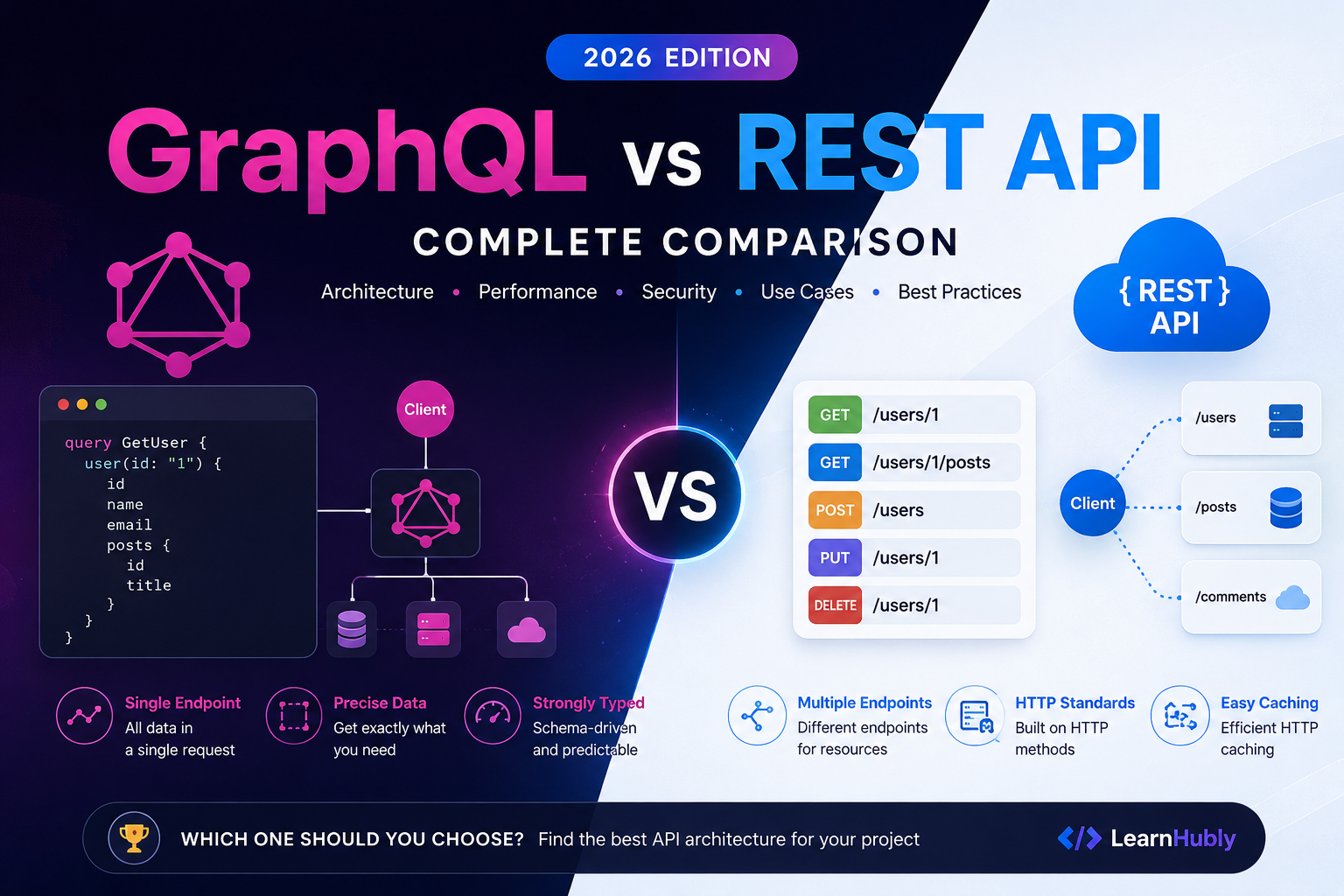
The GraphQL vs REST debate is not about which technology is better. It is about which one is right for your specific situation. I have built systems using both — REST APIs handling millions of requests daily for enterprise clients, and GraphQL layers powering complex mobile dashboards at fintech startups. Neither is universally superior. This guide tells you exactly when to choose each one, what the real trade-offs are, and what I have seen go wrong when teams pick the wrong one for the wrong reasons.
Every few months the discourse reignites: "GraphQL is the future, REST is dead." I have heard this since 2016. REST is not dead. GraphQL is not the future. They are different tools for different problems, and in 2026 the most successful engineering teams I work with use both — REST for public APIs and partner integrations, GraphQL for their own product frontends. The question is not which one to pick forever. It is which one solves your current problem best.
1. What Are APIs and Why This Comparison Matters in 2026
An API — Application Programming Interface — is the contract between two systems. It defines how a client requests data and how a server responds. Every app you use daily is communicating over APIs: your banking app fetching account balances, your news feed loading articles, your dashboard pulling metrics from five different services simultaneously.
For most of the internet's history, REST (Representational State Transfer) was the undisputed standard for building these contracts. Then in 2015, Facebook open-sourced GraphQL — a query language that challenged some of REST's fundamental assumptions. Since then, teams have been asking: should we use REST or GraphQL?
In 2026, this question matters more than ever because:
- Mobile apps demand bandwidth efficiency — sending less data over the wire is measurably better user experience
- Frontends have become dramatically more complex — dashboards pulling from 8 different data sources are normal
- AI-powered applications need flexible data fetching that rigid REST endpoints struggle to provide
- Public API ecosystems are growing — and REST remains the standard developers expect
In 2019 I migrated a mobile app's backend from REST to GraphQL. The API payload size dropped by 62%. Page load time on 3G networks dropped by 1.4 seconds. That was a real win. Two years later I recommended REST for the same company's public partner API — because external developers expected REST, documentation was simpler, and caching worked out of the box. Both decisions were right. The technology served the use case, not the other way around.
2. What Is a REST API?
REST stands for Representational State Transfer. It was defined by Roy Fielding in his 2000 doctoral dissertation as a set of architectural constraints for designing networked hypermedia systems. What started as an academic concept became the dominant paradigm for web APIs over the following decade — because it mapped naturally onto HTTP, which every developer already understood.
REST treats everything as a resource. A user is a resource. An order is a resource. A product is a resource. Each resource has a URL — its address — and you interact with it using HTTP methods that map to operations:
- GET — read a resource or a list of resources
- POST — create a new resource
- PUT / PATCH — update an existing resource
- DELETE — remove a resource
URL examples that follow REST conventions:
REST · resource-based URL patterns
GET    /api/users              → list all users
GET    /api/users/42           → get user with ID 42
POST   /api/users              → create a new user
PUT    /api/users/42           → update user 42 completely
PATCH  /api/users/42           → update user 42 partially
DELETE /api/users/42           → delete user 42

GET    /api/users/42/orders    → get all orders for user 42
GET    /api/users/42/orders/7  → get order 7 for user 42
The key architectural principles that make REST what it is:
- Stateless: every request contains all information needed to process it — the server stores no session state between requests
- Uniform interface: consistent URL patterns and HTTP method semantics across the API
- Cacheable: GET responses can be cached at the HTTP layer — browsers, CDNs, and proxies do this automatically
- Client-server separation: frontend and backend evolve independently
REST's greatest strength is its alignment with HTTP. Every developer who understands HTTP — which is everyone — understands REST. No new language to learn. No special client library required. A curl command is enough to test any REST endpoint.
3. What Is GraphQL?
GraphQL is a query language for APIs and a runtime for executing those queries. Facebook developed it internally in 2012 to solve a specific problem: their mobile app's REST API was returning far more data than mobile clients needed, and making far too many requests to assemble a single screen. They open-sourced it in 2015.
The fundamental idea is different from REST: instead of the server defining what data each endpoint returns, the client specifies exactly what data it needs. You send a query describing your data requirements, and the server returns exactly that — nothing more, nothing less.
GraphQL has three core operation types:
- Query — read data. The equivalent of GET in REST.
- Mutation — write data. The equivalent of POST, PUT, PATCH, DELETE in REST.
- Subscription — real-time data. The server pushes updates to the client when data changes. No REST equivalent.
Everything in GraphQL is defined by a Schema — a strongly typed definition of every type, query, mutation, and subscription your API supports. The schema is the contract between client and server. It is also self-documenting — tools like GraphiQL generate interactive documentation directly from it.
GraphQL · schema definition example
type User {
  id: ID!
  name: String!
  email: String!
  orders: [Order!]!
  createdAt: String!
}

type Order {
  id: ID!
  total: Float!
  status: String!
  items: [OrderItem!]!
}

type Query {
  user(id: ID!): User
  users: [User!]!
}

type Mutation {
  createUser(name: String!, email: String!): User!
  updateUser(id: ID!, name: String): User!
}

type Subscription {
  orderStatusChanged(orderId: ID!): Order!
}
4. REST API Architecture
A REST API follows a client-server model with stateless communication. Understanding this architecture explains both why REST works so reliably and where its limitations appear.
Client: any consumer of the API — a browser, mobile app, another service, a CLI tool, or a curl command. The client knows the URL structure and HTTP methods. It sends requests and processes responses.
Server: receives requests, processes business logic, queries the database, and returns responses. The server maintains no state about the client between requests — each request is independent.
Resources: everything the API exposes is modeled as a resource — a noun. Users, orders, products, payments. Each resource has a unique URL and can be acted upon using HTTP methods.
Endpoints: a REST API has multiple endpoints — one per resource type and action. A typical e-commerce API might have 40–80 endpoints: /products, /products/{id}, /orders, /orders/{id}/items, /users/{id}/addresses, and so on.
Stateless communication: every HTTP request includes all the context the server needs — authentication headers, query parameters, request body. The server processes it in isolation. This is what makes REST horizontally scalable — any server instance can handle any request because no session state is shared.
5. GraphQL Architecture
GraphQL flips the request model. Instead of the server defining what each endpoint returns, the client describes exactly what it needs — and the server fulfills that description.
Schema: the complete description of your data graph. Every type, every field, every relationship. The schema is the source of truth for both server and client. It is strongly typed — every field has a declared type, making it self-documenting and enabling powerful developer tooling.
Resolver: a function that fetches data for a specific field in the schema. When a query requests user.orders, the orders resolver is called. Resolvers can fetch from a database, call a REST API, read from cache, or combine multiple sources.
Query execution: when a client sends a query, GraphQL parses it against the schema, validates it, then calls the relevant resolvers in parallel where possible. The response mirrors the exact shape of the query.
Single endpoint: all GraphQL operations go to one endpoint — typically /graphql. What varies is the query body, not the URL. This means GraphQL does not benefit from URL-based HTTP caching by default.
6. REST API Request Examples
HTTP · GET request — read a user
GET /api/users/42 HTTP/1.1
Host: api.example.com
Authorization: Bearer eyJhbGciOiJSUzI1NiJ9...
Accept: application/json
HTTP · REST GET response — full user object returned
HTTP/1.1 200 OK
Content-Type: application/json
{
"id": 42,
"name": "Priya Singh",
"email": "priya@example.com",
"role": "admin",
"createdAt": "2024-01-15T09:23:11Z",
"lastLogin": "2026-05-09T14:17:00Z",
"address": { "city": "Mumbai", "country": "IN" },
"preferences": { "theme": "dark", "notifications": true }
// ↑ All of these are returned even if you only needed name and email
}HTTP · POST request — create a new user
POST /api/users HTTP/1.1
Host: api.example.com
Authorization: Bearer eyJhbGciOiJSUzI1NiJ9...
Content-Type: application/json
{
"name": "Rahul Sharma",
"email": "rahul@example.com",
"role": "developer"
}
// Response: 201 Created
// Location: /api/users/43
{
"id": 43,
"name": "Rahul Sharma",
"email": "rahul@example.com",
"role": "developer",
"createdAt": "2026-05-10T08:00:00Z"
}Test any REST API without installing Postman — fire GET, POST, PUT, and DELETE requests directly in your browser using LearnHubly's REST API Tester. Inspect headers, response codes, and payloads instantly.
7. GraphQL Query and Mutation Examples
GraphQL · query — request exactly the fields you need
# REST would return 12+ fields. GraphQL returns exactly 2.
query GetUser {
  user(id: "42") {
    name
    email
    # NOT fetching: role, address, preferences, lastLogin
    # Those fields never hit the network
  }
}

# Response:
{
  "data": {
    "user": {
      "name": "Priya Singh",
      "email": "priya@example.com"
    }
  }
}
GraphQL · mutation — create a user and return specific fields
mutation CreateUser {
createUser(input: {
name: "Rahul Sharma"
email: "rahul@example.com"
role: "developer"
}) {
id # only need the new ID back
name # and the name to confirm
# not fetching createdAt, address, preferences
}
}
# Response:
{
"data": {
"createUser": {
"id": "43",
"name": "Rahul Sharma"
}
}
}GraphQL · real power — fetch user + orders in ONE request
# With REST: GET /users/42 then GET /users/42/orders = 2 requests
# With GraphQL: 1 request, 1 response
query UserWithOrders {
user(id: "42") {
name
orders(last: 5) {
id
total
status
}
}
}The last example above is where I personally feel GraphQL earn its keep. A mobile app screen showing user profile + recent orders used to require 2 REST calls with a waterfall dependency (get user ID first, then fetch orders). With GraphQL it became 1 request. On a 4G connection in India that difference was 400–800ms of real latency. For users it was the difference between a screen that felt fast and one that felt slow.
8. GraphQL vs REST API — Complete Comparison Table
| Aspect | REST API | GraphQL |
|---|---|---|
| Endpoint structure | Multiple endpoints (one per resource) | Single endpoint (/graphql) |
| Data fetching | Fixed response — returns all fields defined by server | Client specifies exactly which fields to return |
| Over-fetching | Common — extra unused data returned every request | Eliminated — only requested fields returned |
| Under-fetching | Common — multiple requests needed for related data | Eliminated — related data in one query |
| HTTP Caching | Native — GET requests cached by browsers, CDNs, proxies | Complex — POST queries not cached by default; needs persisted queries |
| Performance (simple read) | Faster — cached GET responses have near-zero latency | Slower — cannot leverage HTTP caching for reads |
| Performance (complex data) | Slower — multiple round trips for related data | Faster — single request fetches graph of related data |
| Versioning | Clean — /v1/, /v2/ URL versioning | Harder — schema evolution via deprecation, no URL versioning |
| Learning curve | Low — maps directly to HTTP everyone knows | Medium — new query language, schema, resolver concepts |
| Type safety | Optional — depends on OpenAPI/JSON Schema | Built-in — strongly typed schema is the contract |
| Security | Simpler — endpoint-level auth, standard rate limiting | More complex — resolver-level auth, depth/complexity limiting needed |
| Documentation | Requires OpenAPI/Swagger tooling | Self-documenting — schema IS the documentation |
| File upload | Native — multipart form data, direct binary upload | Awkward — needs multipart spec extension |
| Real-time data | Manual — polling or SSE required | Built-in — subscriptions for real-time updates |
| Error handling | HTTP status codes — machine-readable and standard | Always HTTP 200 — errors in body, non-standard |
| Mobile apps | Workable — requires careful endpoint design | Excellent — minimal payload, one round trip, battery efficient |
| Public APIs | Standard — external developers expect REST | Unusual — most public APIs are REST; less tooling for consumers |
| Pagination | Simple — offset/cursor via query parameters | Standardised but verbose — connection/edge/node pattern |
| Tooling ecosystem | Enormous — every language, framework, gateway supports it | Strong but smaller — Apollo, Relay, Hasura, Strawberry |
| Microservices | Natural fit — service-to-service communication | Gateway/BFF pattern — aggregates multiple services at edge |
| Introspection / discoverability | Manual discovery — requires documentation | Built-in introspection — clients can query the schema itself |
9. Advantages of REST API
After 15 years building production systems, REST's advantages are not just theoretical. They show up as operational reliability and developer productivity in ways that matter every day.
- HTTP caching works out of the box. A GET to
/api/productscan be cached at the browser, CDN, or API gateway level with zero configuration. This eliminates database load for read-heavy endpoints in a way that GraphQL simply cannot match without significant additional tooling. - Every developer already understands it. REST maps directly onto HTTP — a protocol that every developer learns before they learn any framework. Onboarding a new team member to a REST API takes hours, not days.
- HTTP status codes communicate errors clearly. 404 means not found. 401 means unauthorised. 422 means validation failed. Every HTTP client, monitoring tool, load balancer, and proxy understands these codes and acts on them accordingly. GraphQL returns HTTP 200 for errors — breaking this contract.
- External developer adoption. If you are publishing a public API that third-party developers will consume, REST is what they expect. Their existing tooling — Postman, Insomnia, Swagger UI — works with it immediately.
- File uploads are natural. Multipart form data over REST is a solved problem in every framework. GraphQL file uploads require the multipart request spec and are awkward by comparison.
- Simplicity for simple use cases. A basic CRUD API for a web app does not need a query language. Four endpoints, standard HTTP methods, JSON responses. REST is the right tool for this and adding GraphQL would be over-engineering.
- Rate limiting per endpoint. You can apply different rate limits to different endpoints — stricter limits on write operations, looser on reads. With GraphQL's single endpoint, this granularity requires custom middleware.
10. Advantages of GraphQL
- Eliminates over-fetching and under-fetching. The client gets exactly the data it needs — no more, no less. For mobile applications on limited bandwidth, this is a measurable performance improvement.
- One round trip for related data. Fetching a user profile plus their recent orders plus their preferred address in a single GraphQL query versus 3 REST requests is not just cleaner — it is genuinely faster on high-latency connections.
- Self-documenting schema. The schema is the documentation. GraphiQL and Apollo Sandbox generate interactive documentation automatically from it. The schema and the docs are always in sync because they are the same thing.
- Strong typing prevents entire categories of bugs. The type system catches mismatches between what the client expects and what the server provides at compile time, before they reach production.
- Frontend teams iterate faster. When a product designer changes a screen to show fewer fields, the frontend team does not need to wait for a backend API change. They just update the query to request fewer fields.
- Built-in subscriptions for real-time. GraphQL subscriptions provide a standardised, schema-driven approach to real-time data without bolting on a separate WebSocket protocol.
- Excellent for aggregating multiple services. A GraphQL gateway can sit in front of multiple microservices or REST APIs and present a unified graph to the frontend — without the frontend needing to know about the service boundaries underneath.
11. Disadvantages of REST API
- Over-fetching is structural. REST endpoints return what the server defines. If the
/users/{id}endpoint returns 20 fields and you need 2, you are fetching 18 fields on every request. At scale, this is wasted bandwidth and database load. - Multiple round trips for related data. Fetching a user and then their orders requires at least 2 requests. In a mobile app with high latency, this waterfall pattern is a real performance problem.
- Versioning accumulates technical debt.
/v1/users,/v2/users,/v3/users— supporting multiple API versions for external consumers who cannot upgrade quickly is a genuine maintenance burden over time. - Documentation is a separate concern. REST APIs require external tooling — Swagger, OpenAPI, Postman collections — to be discoverable and documented. These must be kept in sync with the actual API manually.
- No real-time standard. REST has no built-in mechanism for the server to push updates to clients. Polling wastes resources. Server-Sent Events and WebSockets are bolted on separately.
12. Disadvantages of GraphQL
- HTTP caching is broken by default. All GraphQL queries typically use POST requests to a single endpoint, which HTTP caches treat as non-cacheable. You need persisted queries and custom caching strategies to recover caching behaviour that REST gets for free.
- Error handling is non-standard. GraphQL always returns HTTP 200 — even when the query fails. Errors are embedded in the response body. This breaks HTTP-level monitoring, load balancer health checks, and every tool that reads status codes.
- Security requires more discipline. The flexible query structure lets clients craft deeply nested, expensive queries. Without depth limiting and query cost analysis, a malicious query can DoS your database. REST endpoints have a fixed cost per request.
- Complexity for simple use cases. Setting up a GraphQL server — schema, resolvers, type definitions, caching layer — is meaningfully more work than a simple REST CRUD API. For a basic internal service, that complexity is not justified.
- N+1 query problem. Naive GraphQL implementations hit the database once per item in a list — fetching 100 users generates 100 database queries for their orders. Requires DataLoader or batching to solve.
- File uploads are awkward. Not part of the core specification. Requires the multipart request spec — an extension with inconsistent support across server libraries.
13. Performance Comparison — Over-Fetching, Under-Fetching, and Round Trips
Performance is the most nuanced part of this comparison, and the one most frequently oversimplified. The answer is genuinely "it depends" — but in specific, measurable ways.
Over-fetching (REST loses)
REST returns what the server defines for that endpoint. A mobile app showing only a user's name and avatar calls GET /users/42 and receives 20 fields including address, preferences, billing info, and activity history. 18 of those fields travel the network, get parsed, and get discarded. On a slow mobile connection, that wasted bandwidth is real.
Under-fetching and multiple requests (REST loses)
Assembling a dashboard showing user profile + recent orders + payment methods requires 3+ REST calls in sequence — you need the user ID before you can fetch orders. This waterfall pattern is expensive on high-latency connections. GraphQL resolves this with a single query that fetches the entire graph at once.
Simple reads with caching (REST wins)
A product listing page hitting a cached CDN endpoint returns in under 10ms. The same data through GraphQL requires a POST request that bypasses standard HTTP caching, hits the server, and runs the query. For high-traffic read operations, REST with proper caching has significantly better performance characteristics.
Real-world numbers from my projects
The mobile app migration I mentioned earlier: switching from 3 REST calls to 1 GraphQL query reduced median API response time from 890ms to 340ms on 4G — a 62% improvement. But the same team's product listing page performed 40% worse after a GraphQL migration attempt because caching was lost. We reverted that page to REST. Both technologies stayed in the codebase, each in its right place.
Understand HTTP status codes and what they mean for your API's performance characteristics — see LearnHubly's HTTP Status Codes Decision Tree for the senior developer guide to returning the right response.
14. Security Comparison
Security is where GraphQL requires the most additional attention. This is not a reason to avoid it — but it is a reason to plan for it explicitly.
Authentication
Identical for both. JWT Bearer tokens in the Authorization header, OAuth2 flows, API keys — all the same regardless of whether your API is REST or GraphQL. Authentication is a transport-layer concern that sits above both.
Authorization
This is where REST has a structural advantage. In REST, authorization is endpoint-level — you protect the /admin/users route with a role check. In GraphQL, a single endpoint serves all operations. Authorization must be enforced at the resolver level — each field resolver must check whether the requesting user has permission to access that specific field. This is more granular but also more error-prone. Forgetting to add an auth check to one resolver exposes that field to everyone.
Rate Limiting
REST: limit per endpoint. Simple, granular, effective. GraphQL: limiting per request to the single endpoint is too blunt — a single simple query and a complex nested query are treated the same. Proper GraphQL rate limiting requires query cost analysis — assigning a complexity score to each query and rejecting those above a threshold.
Query Depth Limiting
GraphQL-specific concern. Without depth limiting, a client can send a query like { user { orders { user { orders { user... } } } } } — infinitely nested, crashing your database. Implement maximum query depth (typically 10–12 levels) in your GraphQL server configuration.
Introspection in Production
GraphQL's schema introspection — querying the schema itself — is invaluable in development. In production, it hands attackers a complete map of your data model. Disable introspection in production environments.
Before any API goes to production, run through the OWASP Top 10 API Vulnerabilities checklist — it covers injection, BOLA, and authentication failures that affect both REST and GraphQL equally.
15. Which Companies Use GraphQL?
GraphQL is no longer a Facebook-only technology. It is now running at production scale in some of the largest engineering organisations in the world — though notably, in most cases alongside REST, not replacing it.
- Meta: invented GraphQL to solve their mobile app's data fetching problems. Still runs at the core of their product APIs.
- GitHub: the GitHub GraphQL API (api.github.com/graphql) was launched in 2016 alongside their REST API. GitHub explicitly says the GraphQL API "offers more flexibility" and is the recommended API for complex integrations.
- Shopify: Shopify's storefront and admin APIs are built on GraphQL. Their public documentation pushes GraphQL as the primary API for third-party app development.
- Netflix: uses GraphQL federation extensively for their internal APIs that power their UI layer — aggregating data from hundreds of microservices.
16. Which Companies Use REST APIs?
The more relevant question might be: which companies do not use REST? Almost every company with a public API uses REST as the primary standard for external developers.
- Stripe: one of the best-designed REST APIs in existence. It is the standard example referenced when teaching REST API design. Stripe's REST API is the reason developers trust Stripe — because it just works predictably.
- Twilio: all communication APIs (SMS, voice, WhatsApp) are REST. Simple, predictable, easy to integrate with any language.
- Google: Google Maps, YouTube, Gmail, Calendar — all REST. When you need external developers to build on your platform, REST is the lingua franca.
- GitHub: note that GitHub uses both — REST API v3 for backward compatibility and external tooling, GraphQL API v4 for complex queries. This is the pattern I see in most mature organisations.
17. When Should You Choose REST?
Choose REST when the constraints and context of your project align with what REST does best.
Public APIs for third-party developers
If external developers will consume your API, REST is the expected standard. They have existing tooling — Postman, curl, language SDKs — that works with REST immediately. Choosing GraphQL for a public API forces consumers to learn a new query language before they can integrate. For every developer who finds this interesting, ten find it a barrier.
Simple CRUD operations
A user management system. An inventory API. An order tracking service. These are four endpoints with four HTTP methods. Adding GraphQL to this is engineering theatre — complexity for its own sake, solving problems that do not exist.
Systems where caching matters most
High-traffic content APIs, product catalogues, news feeds — anything where GET responses can be cached at the CDN or browser level. REST's natural HTTP caching alignment is a genuine performance advantage here.
Microservice-to-microservice communication
Each service in a microservices architecture exposes its own REST API. Service A calls Service B's REST endpoint. This is clean, simple, and aligns with the bounded context principle. GraphQL is for the edge — not for internal service communication.
Teams new to API development
REST's alignment with HTTP means every developer on the team already has the mental model needed to understand it. GraphQL's query language, schema, and resolver pattern require dedicated learning time. For teams building their first API, REST gives you working software faster.
18. When Should You Choose GraphQL?
GraphQL solves specific, real problems. Choose it when those problems are your problems.
Mobile applications with bandwidth constraints
Mobile users are on variable-quality networks. Sending 30 fields when 5 are needed wastes battery and bandwidth. GraphQL's precise data fetching is measurably better for mobile — as my own project numbers demonstrated.
Complex dashboards aggregating multiple data sources
An analytics dashboard showing user metrics, revenue data, performance indicators, and recent events — each from a different service. With REST you make 4–8 API calls to assemble one screen. With GraphQL you make 1. The UX difference is visible.
Rapidly evolving frontends
When product iterations change what data a screen needs weekly, GraphQL lets the frontend evolve queries independently of the backend. A REST API would need a new endpoint or versioning for each screen change.
BFF (Backend for Frontend) pattern
A GraphQL gateway sits in front of your microservices and REST APIs, aggregating data into a unified graph optimised for your specific frontend. The microservices stay as REST. The GraphQL layer is an adapter — not a replacement.
Internal product APIs
Your own web and mobile apps are the consumers — not external developers. You control both sides. The schema is the contract between your teams. This is exactly the use case GraphQL was built for.
19. REST vs GraphQL: Which One Should You Learn in 2026?
GraphQL builds on REST's concepts. Understanding HTTP, status codes, request/response cycles, and API design principles is foundational for both. Skip this foundation and GraphQL's abstractions make no sense.
If you are a beginner: Learn REST completely first. Understand HTTP methods, status codes, headers, JSON, and API design before touching GraphQL. REST will get you employed, get your side projects working, and teach you the mental models that underpin all API work. Once you are comfortable with REST, GraphQL becomes a natural extension — not a new paradigm.
If you are a backend developer: You need both. Your service-to-service APIs will be REST. But modern product companies expect you to understand GraphQL schema design, resolver patterns, and the N+1 problem. Being able to build a GraphQL gateway that sits on top of your REST microservices is a high-value skill in 2026.
If you are a frontend developer: GraphQL is probably more immediately relevant to your day job. Apollo Client, urql, and TanStack Query with GraphQL are the tools modern frontend teams use. The query language also matches how frontend developers think about data — request what you need for this screen, nothing more.
If you are a full-stack developer: Know both deeply. The best architecture decision you can make for a product in 2026 is often: REST APIs for anything external-facing or service-to-service, GraphQL BFF layer for your web and mobile product. You need to be comfortable with both to implement that pattern.
20. Frequently Asked Questions
No. GraphQL is not replacing REST — it is complementing it. REST remains the dominant standard for public APIs, simple CRUD, and systems needing HTTP caching. GraphQL excels in complex frontend applications, mobile apps, and dashboards aggregating multiple data sources. The industry in 2026 uses both, often in the same organisation — REST for public-facing APIs, GraphQL for internal product APIs.
It depends on the use case. GraphQL eliminates over-fetching and reduces round trips for complex data — typically faster for mobile and dashboard use cases. But REST with HTTP caching outperforms GraphQL for simple cached reads. For high-traffic content endpoints, REST with a CDN can be 10–100x faster. For mobile apps loading a complex screen in one request, GraphQL can be 2–3x faster than multiple REST calls.
Yes. GraphQL is transport-agnostic but runs over HTTP in almost every production implementation. Queries are typically sent as POST requests. Queries can also use GET requests for cacheable operations using persisted queries. GraphQL does not replace HTTP — it uses HTTP as the transport layer, the same as REST.
GraphQL can be secure but requires more deliberate effort than REST. Key requirements: disable schema introspection in production, implement query depth limiting to prevent deeply nested abuse, add query cost analysis for rate limiting, enforce authorization at the resolver level (not just the endpoint), and use the same JWT/OAuth2 authentication you would use for REST. The security work is different, not harder — just different.
Yes — and this is the most common production pattern. Public REST API for third-party consumers, GraphQL API for your own web and mobile frontend. The GraphQL layer can aggregate data from your existing REST microservices. This federation approach lets you adopt GraphQL incrementally without abandoning REST infrastructure that is working well.
GraphQL supports caching but it requires explicit tooling — not automatic HTTP caching. Apollo Client's InMemoryCache handles client-side caching. Persisted queries (hashed query strings sent as GET parameters) enable CDN caching. Server-side caching with DataLoader handles database query deduplication. None of this is automatic — REST's HTTP caching is significantly simpler for standard use cases.
REST is significantly easier to learn. It maps directly to HTTP — a protocol every developer learns before any framework. curl, Postman, or a browser is all you need to test it. GraphQL requires learning the query language, schema definition language, resolver concept, client-side caching strategy, and the N+1 problem. Learn REST first. GraphQL will make much more sense once you fully understand what problems it is solving.
REST for service-to-service communication — each service exposes its own REST API with clean resource boundaries. GraphQL at the edge — as a gateway or BFF (Backend for Frontend) that aggregates data from multiple microservices and serves the frontend in a single query. Apollo Federation and GraphQL Mesh are designed exactly for this pattern. Use REST internally, GraphQL externally toward your frontend.
"There is no universally correct answer. There is only the right tool for the specific problem in front of you."
21. Final Verdict — Which One Should You Choose?
✅ Choose REST when...
- Building a public API for external developers
- Simple CRUD operations with predictable data shapes
- Caching performance is critical (content, product catalogues)
- Service-to-service communication in microservices
- Team is new to API development
- File upload is a core requirement
- You need endpoint-level rate limiting
- Building for legacy system integration
✅ Choose GraphQL when...
- Mobile apps with bandwidth/battery constraints
- Complex dashboards from multiple data sources
- Frontend teams need to iterate independently
- Real-time features via subscriptions
- Internal product API (you control both sides)
- BFF aggregating multiple microservices
- Strongly typed API contract between teams
- Rapidly changing data requirements
No Universal Winner — Only the Right Tool for Your Problem
I have seen teams adopt GraphQL because it was fashionable and spend months fighting caching problems that REST would have solved for free. I have seen teams stick with REST long past the point where GraphQL would have dramatically improved their mobile app performance — out of familiarity and resistance to learning something new. Both are mistakes in different directions.
The pattern I recommend to most teams in 2026: start with REST, understand it completely, ship with it, and then evaluate GraphQL for specific use cases where its strengths directly address your problems. GraphQL is an excellent solution to real problems — over-fetching, multiple round trips, evolving frontends. It is not a solution to problems that do not exist yet.
If I am starting a new project today: public API for partners — REST, no question. Mobile product API — GraphQL BFF on top of REST microservices. Internal admin dashboard — GraphQL. Simple CRUD web app — REST. The right answer changes with context. — Priya
Test REST and GraphQL APIs Right Now
No Postman needed. Fire requests, inspect responses, and generate code snippets in your browser.